

For high-earning professionals building wealth for the future, the traditional Roth IRA has long represented the gold standard of retirement accounts. Offering tax-free growth and completely tax-free withdrawals in retirement, it is an exceptionally powerful tool. Unfortunately, the federal government imposes strict income limits that slam the front door on high earners. If your modified adjusted gross income exceeds the annual IRS threshold, you are legally prohibited from making direct contributions to a Roth IRA.
To bypass this barrier, sophisticated tax planners and investors embrace a clever, IRS-approved workaround known as the Backdoor Roth IRA. By making a non-deductible contribution to a traditional IRA and immediately converting those funds into a Roth IRA, high earners can successfully fund their Roth accounts. Yet, this strategy carries a hidden, highly punitive landmine known as the pro-rata rule. Falling into the pro-rata tax trap can turn a tax-advantaged maneuver into an expensive tax nightmare. Understanding how the rule works and mastering how to avoid it is essential for anyone executing a backdoor Roth strategy.
Understanding the Mechanics of the Backdoor Roth
To appreciate where the pro-rata trap springs from, you first need to understand the two-step choreography of a clean backdoor Roth conversion.
Step one involves making a non-deductible contribution to a traditional IRA. Because your income is too high to claim a tax deduction, you contribute after-tax dollars. You do not receive an immediate tax break on your tax return, but because the contribution used after-tax money, the principal amount is tracked as your cost basis.
Step two involves converting that traditional IRA balance into a Roth IRA. Because you already paid income taxes on those contributions, you should theoretically owe zero tax on the conversion. Once the funds land inside the Roth IRA, they begin their journey of tax-free growth. For individuals with zero existing pre-tax IRA balances, this two-step process is clean, elegant, and entirely tax-free. The complication arises when pre-tax money enters the equation.
The Pro-Rata Rule: The IRS Aggregate View
The Internal Revenue Service does not view your individual IRA accounts in isolation. When you execute a Roth conversion, the IRS looks at all of your traditional, SEP, and SIMPLE IRAs as if they were blended together into one giant, universal pool of money.
This brings us to the pro-rata rule, formally governed by Internal Revenue Code Section 408(d)(2). The rule dictates that you cannot cherry-pick which dollars you convert. You cannot isolate your brand-new, after-tax non-deductible contribution and say you only want to convert those specific dollars while leaving your pre-tax money behind. Instead, every single conversion is treated as a proportional mix of your overall IRA portfolio, combining both pre-tax and after-tax funds.
A Mathematical Example of the Trap
Imagine you have an old traditional IRA holding ninety thousand dollars in pre-tax money—contributed via deductions or rolled over from past employer-sponsored plans over the years. You decide to execute a backdoor Roth, so you open a new traditional IRA and contribute six thousand dollars of fresh after-tax money. Your total IRA universe is now ninety-six thousand dollars, split between ninety thousand of pre-tax dollars and six thousand of after-tax basis. That means roughly ninety-three point seven percent of your total balance is pre-tax, while only six point two percent is after-tax basis.
If you attempt to convert that six-thousand-dollar after-tax contribution into a Roth IRA, the pro-rata rule steps in. The IRS mandates that your conversion must consist of the exact same proportional mix. You cannot convert just your after-tax dollars; you must convert ninety-three point seven percent pre-tax money and six point two percent after-tax money. Consequently, out of your six-thousand-dollar conversion, you will be forced to pay ordinary income tax on fifty-six thousand two hundred dollars of pre-tax money that you accidentally dragged along with it. The clean backdoor maneuver is completely ruined by a massive, unexpected tax bill.
Strategy One: The Reverse Rollover Into a Current Employer Plan
If you currently have a large balance sitting in traditional IRAs from past jobs, facing the pro-rata rule can feel paralyzing. Fortunately, the tax code provides a powerful escape hatch known as a reverse rollover.
The pro-rata rule applies exclusively to traditional, SEP, and SIMPLE IRAs. It does not apply to employer-sponsored retirement plans like a current 401(k), 403(b), or governmental 457(b) plan. If your current employer allows it, you can roll the pre-tax money out of your traditional IRAs and into your current workplace retirement plan.
By executing a reverse rollover, you successfully sweep all your pre-tax funds out of the IRA ecosystem and into a qualified employer plan. Your traditional IRA balance drops to zero, leaving only your fresh, non-deductible after-tax contribution sitting alone in the account. When you convert those funds to a Roth IRA, one hundred percent of the balance consists of after-tax basis, resulting in a completely tax-free conversion and completely bypassing the pro-rata trap.
Strategy Two: Phased Conversions Over Time
If your current employer plan does not accept incoming rollovers—a frustrating reality with many corporate 401(k) plans—or if you are self-employed and lack a workplace plan entirely, you must evaluate alternative mitigation strategies. One approach is executing phased conversions over time, though this requires extreme mathematical caution.
Instead of keeping pre-tax money and trying to sneak backdoor contributions past it, some taxpayers choose to systematically convert their entire traditional IRA balance into a Roth IRA over several years, paying the income taxes incrementally to clear the slate. Once the traditional IRA balance is completely cleaned out and converted to Roth, future backdoor contributions can occur with zero pro-rata interference. This strategy works best if you anticipate dropping into a lower tax bracket in future years, such as during early retirement before taking Social Security or drawing pensions.
Strategy Three: Strategic Timing and Avoiding the Year-End Trap
Tax execution timing plays a massive role in avoiding unintended penalties. When calculating the pro-rata rule, the IRS evaluates the aggregate balance of all your traditional IRAs as of December thirty-first of the year in which you make the conversion.
This creates a subtle trap that catches many high earners off guard. For example, you might make a non-deductible traditional IRA contribution in January, immediately convert it to a Roth IRA, and feel confident that your hands are clean. However, if you later roll over a pre-tax traditional 401(k) balance from an old employer into a traditional IRA in December of that exact same calendar year, the IRS recalculates your pro-rata percentage looking at your year-end balance. That late-year rollover retroactively contaminates your earlier conversion, triggering a surprise tax liability.
To prevent this, always ensure your traditional IRA balances are completely cleared of pre-tax money before you execute a Roth conversion, and double-check that no stray rollover checks land in a traditional IRA during the conversion calendar year.
Accurate IRS Reporting With Form 8606
Executing a backdoor Roth IRA correctly is as much an administrative task as it is a financial one. If you fail to report your non-deductible contributions properly to the IRS, you run the risk of being taxed twice on the exact same money—once when you earned it, and again when you withdraw it in retirement.
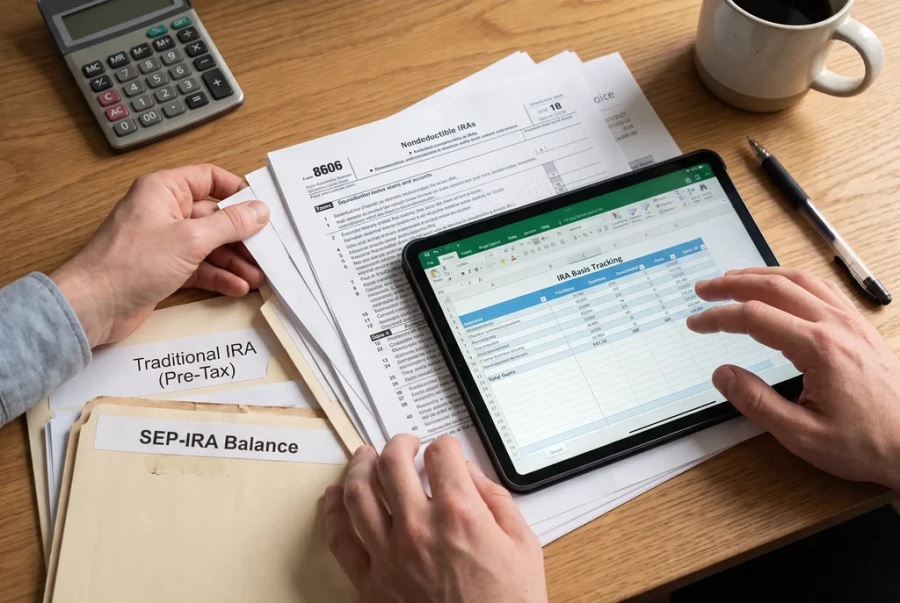
The essential tool for this documentation is IRS Form 8606, Nondeductible IRAs. Every single year you make a non-deductible contribution to a traditional IRA, you must file Form 8606 with your federal tax return. This form tracks your cumulative after-tax cost basis over time. When you execute your Roth conversion, Form 8606 calculates the taxable versus non-taxable portions using the pro-rata formula, ensuring the IRS knows that your conversion used after-tax dollars. Keeping meticulous copies of every Form 8606 you file is a mandatory habit for successful backdoor Roth investors.
Navigating the backdoor Roth IRA strategy offers high-earning individuals an incredible vehicle for tax-free retirement growth, but it leaves zero margin for administrative sloppiness. By understanding how the IRS aggregates your accounts through the pro-rata rule, utilizing reverse rollovers into workplace plans, timing your transactions meticulously, and filing Form 8606 with religious precision, you can successfully bypass the tax traps and secure your financial future with absolute confidence.

Comments are closed.